
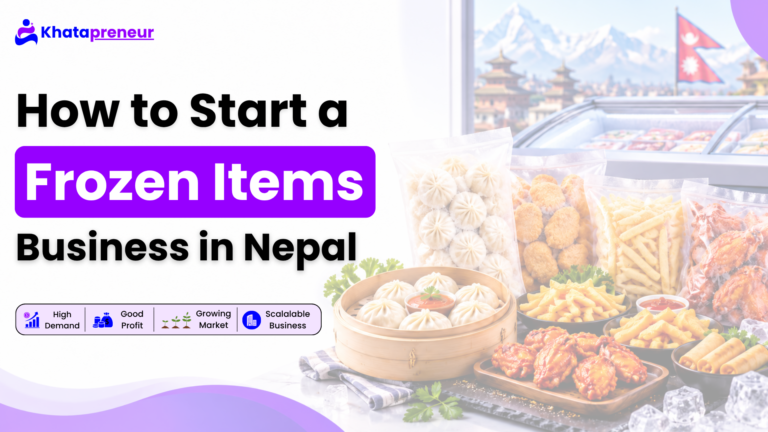
How to Start a Frozen Food Business in Nepal
Learn how to build a Frozen Food Business around convenience, consistent quality and proper systems — from Frozen Momo and packaging to costing, distribution and marketing.
Thinking about starting a Frozen Food Business in Nepal? The first thing to understand is that this business is not simply about putting Momo inside a freezer and selling it. You are actually selling convenience.
Customers want food that can be stored easily, prepared quickly and still provide a consistent taste and quality whenever they cook it.
Start With One Strong Frozen Product
Suppose you decide to start with Frozen Momo. Instead of launching a large range immediately, start with a few carefully selected options.
- Chicken Momo
- Buff Momo
- Veg Momo
Your initial goal should be to standardise the taste, size, filling, portion and packaging of every product.
Expand Your Product Range Gradually
Once demand starts growing and your first product becomes consistent, you can gradually add more frozen food items.
- Chicken Wings
- Burger Patties
- Chicken Nuggets
- Sausage
- Spring Rolls
- French Fries
- Samosa
- Kebab
Product expansion should happen only when your production capacity and quality-control system can handle the additional products properly.
Make Consistency Your Competitive Advantage
One of the most important factors in a Frozen Food Business is consistency.
When a customer opens a packet today and purchases the same product again later, they should receive a similar experience.
Product size, filling, taste, cooking result and overall quality should remain consistent across different production batches.
Build a Proper Production System
Frozen Food Business requires more than simply cooking products and storing them inside a freezer.
Your production process should clearly cover:
- Raw material selection
- Production
- Portioning
- Freezing
- Packaging
- Expiry labelling
- Cold storage
- Inventory management
- Delivery and handling
Each step should have a repeatable process, especially when production volume begins to increase.
Make the Business Legally Ready
Before operating commercially, decide how your Frozen Food Business will be structured and complete the required business registrations.
Depending on your business structure, this may involve business or company registration, PAN or VAT where applicable, local registration and other approvals relevant to your food-production activity.
Because frozen food involves production, packaging, storage and distribution, entrepreneurs should also confirm the food-safety, labelling and other applicable regulatory requirements before commercial production.
Need Help With Business Registration?
Company Khata supports entrepreneurs with company registration, documentation and ongoing business compliance.
If you want to operate your Frozen Food Business through a company structure, Company Khata can support you with company-registration guidance, documentation, company objectives and related registration procedures.
Support is also available for areas such as PAN/VAT documentation, trademark, accounting, taxation and ongoing company compliance.
If you are planning to build your frozen products under a unique brand, you may also consider protecting the business name and logo as the brand grows.
Visit Company KhataCalculate the Real Cost of Every Product
Costing mistakes can create serious problems in a Frozen Food Business.
Do not decide your selling price by looking only at meat, flour or other ingredients. Your actual product cost can include:
- Raw materials
- Packaging
- Freezer and refrigeration cost
- Electricity
- Labour
- Delivery
- Wastage
- Storage
- Retailer or reseller margin
Plan the Investment and Working Capital
Frozen Food Business may require investment in production equipment, freezers, packaging tools, storage, ingredients, branding and distribution.
But initial setup cost is only one part of the requirement. The business also needs enough working capital for ingredients, salaries, electricity, packaging, delivery and other regular expenses.
Keeping sufficient working capital is important because cash may remain tied up in frozen inventory before products are sold.
Do Not Depend Only on Direct Customers
A Frozen Food Business can sell directly to consumers, but the business can also grow by supplying other businesses.
Sell Convenience Through Your Marketing
Frozen Food marketing should not focus only on showing the packet.
Show customers how quickly and easily the food can be prepared.
- Cooking demonstration videos
- “Ready in Minutes” content
- Air-fryer preparation videos
- Before-and-after cooking videos
- Family meal ideas
- Combo-pack promotions
- Customer reviews
Social media platforms such as TikTok, Instagram, Facebook and WhatsApp can be useful for showing product preparation, convenience and offers.
Create Combo Packs and Family Packs
Another way to increase customer convenience and potentially increase average order value is through bundled products.
Keep Accounting and Tax Records Properly
As the business grows, regularly track purchases, production costs, sales, inventory, wastage, staff expenses, electricity, delivery expenses and bank transactions.
Proper records help the owner understand gross profit, net profit and cash flow instead of looking only at total sales.
Accurate accounting also helps make PAN, VAT, TDS, income tax and return filing easier to manage where applicable.
Build a Business That Can Run Through Systems
In the beginning, the owner may personally manage suppliers, production, packaging, customer orders and delivery.
But if every activity continues to depend on the owner, scaling becomes difficult.
Build clear systems for:
- Purchasing
- Production
- Portion control
- Quality checking
- Inventory
- Cold storage
- Packaging
- Delivery
- Staff responsibilities
- Customer complaints
What Does the Customer Really Want?
At the end of the day, a Frozen Food customer is usually looking for three simple things:
Build Your Business With Khatapreneur Startup School
If you are planning to start a Frozen Food Business or any other startup and want to practically understand Business Planning, Legal Setup, Accounting, Taxation, Finance, Marketing and Management, explore Khatapreneur Startup School.
Do not just start the business. Learn how to build it with a proper structure, financial understanding and operating system.
Explore Khatapreneur